

On VE Day 1945 I believe Flt Sgt Ron Chapman was on more than one mission.
His log book shows he flew a Douglas Dakota Mark III(KG 320) from RAF Broadwell in Oxfordshire making a quick stop at RAF Hartford Bridge, nr. Reading, before continuing on to Germany and then Denmark.
He was with 575 Squadron, which at the time, was tasked with ferrying war wounded to hospital, moving supplies and bringing former Allied Prisoners of War (PoWs) home.
Often that meant having Flying Nightingales as passengers – the first group of British women on active service allowed into war zones. Mainly nurses, they received an extra 8 old pence a day danger money.
Their role was to care for wounded men and the PoWs. Three are pictured in the photo above.
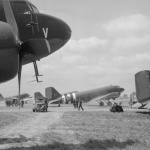
But my father had another task. With the war over, souvenir hunting was rife. People mainly wanted military ‘memorabilia’.
After landing in northern Germany, he saw a pile of guns on the tarmac. Helping himself, he made sure he had enough to bring back.
Four days earlier, near the airfield, Field Marshall Montgomery had accepted the unconditional surrender of German forces in the Netherlands, northwest Germany and Denmark.
To reinforce the surrender in Denmark, British airborne troops were sent to Copenhagen to supervise the German surrender.
Flt Sgt Chapman and his fellow pilot, Flt Lt Sandford, took off for a 90 minute flight to Copenhagen, probably carrying some of parachute troops.
Crowds, waving, cheering and saluting, greeted the British who were escorted by an armada of cyclists. Meanwhile the 30,000 German troops left in Denmark set off to march back to their defeated country with Danish boos ringing in their ears.